image
    Member Center
    Exit
    Data is empty
    0
    Home Blog Blog Salt Spray Testing - Principles, Methods and Standards
    Salt Spray Testing - Principles, Methods and Standards

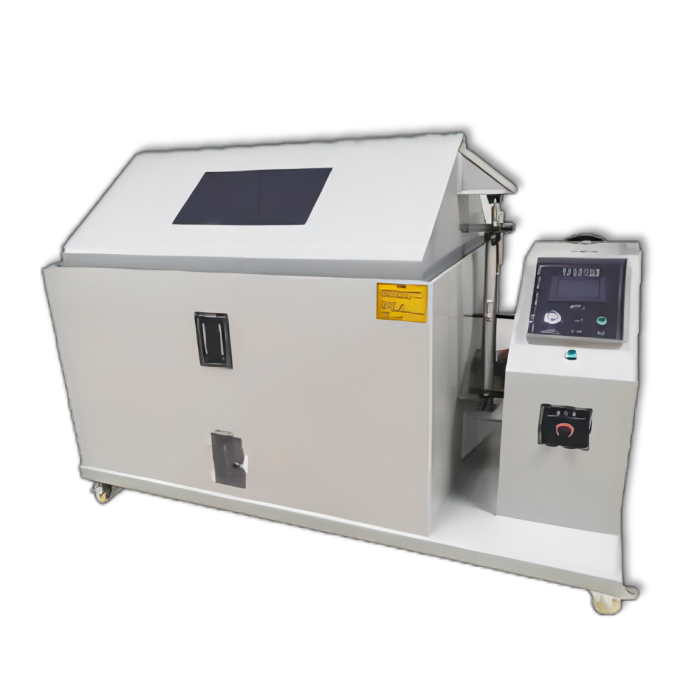
    Salt Spray Testing Machine
    Salt spray testing, also known as salt spray testing or salt corrosion testing, is used in various industries to evaluate the corrosion resistance of materials and coatings. This procedure simulates the effects of corrosion in marine environments or other harsh conditions with high concentrations of salt air, and is also used to test products for changes in their natural environment. Typically a test duration of 24-500 hours is sufficient to simulate corrosion changes in materials over days or even years. Here, we will delve into the full scope of salt spray testing, including principles, methods and test standard.

    Principles of Salt Spray Testing

    Salt spray testing is actually an accelerated corrosion process that typically uses a sodium chloride solution to simulate a corrosive medium. As the chloride ions in sodium chloride penetrate the oxidized and protective layers on the metal surface, an electrochemical reaction occurs with the metal resulting in corrosion of the product. Chlorine ions contain hydration energy, easy to be adsorbed in the pores of the metal surface, cracks crowded and replace the oxygen in the oxide layer, the insoluble oxides into soluble chlorides, so that the passivation of the state of the surface into an active surface. Therefore, the corrosion reaction in the salt spray test is caused by the electrochemical reaction between chloride ions and metals and the activation of metal surfaces.

    Methods of Salt Spray Testing

    Salt spray testing consists of four main methods, Neutral Salt Spray Test, Accelerated Acetate Spray Test with Copper Salt, Acetate Spray Test and Alternating Salt Spray Test.
    1. Neutral salt spray test, also known as NSS test, is currently the most widely used and appeared the earliest of an accelerated corrosion test method. Generally 5% sodium chloride saline solution is used, and the solution PH value is adjusted in the neutral range (6.5-7.2), which is used as a spray. The test temperature is controlled at 35 ℃, the sedimentation rate of salt spray should be 1 ~ 2ml/80cm/h.
    2. Copper salt accelerated acetate fog test, also known as CASS test, is a rapid salt spray corrosion test developed in recent years. Test temperature of 50 ℃, salt solution with a small amount of copper salt - copper chloride, with a strong corrosion-inducing ability, corrosion rate is about 8 times the NSS test.
    3. Acetic acid salt spray test, also known as ASS test, is established on the basis of neutral salt spray test developed. Add glacial acetic acid in 5% sodium chloride solution, the PH value of the solution is reduced to about 3, the solution becomes acidic, and the final formation of salt spray also becomes acidic from neutral salt spray. The corrosion rate is about 3 times that of the NSS test.
    4. Alternating salt spray test is a comprehensive salt spray test, which is based on the principle of neutral salt spray test plus constant humidity and heat test. Mainly used for cavity type machine products, through the penetration of the humid environment, so that the salt spray corrosion occurs both on the surface of the product, but also inside the product. Alternating salt spray test will be the product environment in the salt spray and humidity and heat under the two conditions of continuous replacement, and finally assess the whole product of the electrical and mechanical properties of the degree of change.

    Test Standard of Salt Spray Testing

    Test

    Test Standard

    Description

    Salt Spray Testing

    ISO 7253-1996

    Corrosion tests in artificial atmospheres - Salt spray tests

    BS 3900-F12-1997

    Methods of test for paints - Salt spray (fog) test

    BS 7479:1991

    British Standard methods for resistance to atmospheres containing sulfur dioxide

    IEC 60068-2-11:1981

    Environmental testing - Part 2: Tests - Test Ka: Salt mist

    GB/T 10125-1997

    Corrosion tests in artificial atmospheres - Salt spray tests

    GB 2423.17-2008

    Environmental testing for electric and electronic products - Part 2: Test method Test Ka: Salt mist

    DIN 50021-1988

    Testing of metallic coatings - Salt spray testing

    Acetic Acid Salt Spray Testing

    ASTM B368-09

    Standard test method for copper-accelerated acetic acid-salt spray (fog) testing (CASS Test)

    ISO 9227-2006

    Corrosion tests in artificial atmospheres - Salt spray tests

    DIN 50021-1988

    Testing of metallic coatings - Salt spray testing

    BS 7479:1991

    British Standard methods for resistance to atmospheres containing sulfur dioxide

    Copper Ion Accelerated Salt Spray Testing

    ASTM B368-09

    Standard test method for copper-accelerated acetic acid-salt spray (fog) testing (CASS Test)

    ISO 9227-2006

    Corrosion tests in artificial atmospheres - Salt spray tests

    DIN 50021-1988

    Testing of metallic coatings - Salt spray testing

    BS 7479:1991

    British Standard methods for resistance to atmospheres containing sulfur dioxide

    Cyclic Salt Spray Testing

    ASTM D6899-2003

    Standard practice for sliming resistance of coatings with copper accelerated acetic acid salt spray or copper accelerated acetic acid salt fog exposure

    ASTM G85-02e1 Annex A5

    Standard practice for modified salt spray (fog) testing

    ISO 11997-1:2005

    Paints and varnishes - Determination of resistance to cyclic corrosion conditions - Part 1: Wet (salt fog)/dry/humidity/UV light

    ISO 11997-2:2000

    Paints and varnishes - Determination of resistance to cyclic corrosion conditions - Part 2: Wet (salt fog)/dry/UV light

    SAE J2334:2002

    Laboratory Cyclic Corrosion Test

    WSK-M2G299

    Corrosion test, cyclic

    GM4298P

    Accelerated cyclic corrosion test

    GM4476P

    Cyclic corrosion test

    GM9540P

    Cyclic corrosion tests for vehicle components

    Release time: 2024-02-22

    How to Recycle Your Kitchen Food Waste with a Compost Bin

    The Manufacturing Process of Canisters
    Related Products
    image
    TU2266
    image
    TU3607
    image
    TU3769
    image
    TU0338
    image
    OT3511
    image
    WC1488
    image
    WC3889
    image
    WC1664
    image
    WC3954
    image
    WC1248
    image
    WC1583
    image
    WC1582
    image
    WC1584
    image
    WC3824
    image
    WC3529
    image
    WC1663
    Related blog
    2026-08-25 |Vicky
    Global Food-Grade Testing Standards by Country: A 2026 Compliance Guide for Metal & Tin
    2026-07-23 |Vicky
    Christmas Entertaining in Style: Festive Tablescapes with Metal Partyware
    2026-06-26 |Vicky Yuen
    Summer BBQ & Outdoor Party Essentials: Why Metal Drink Tubs Beat Plastic Coolers
    2026-06-25 |Vicky Yuen
    The Perfect Watering Can:A Complete Guide to Choosing, Using & Styling

    Home

    Products

    OEM

    News

    About Us

    FAQ

    Send Inquiry

    Design Resources

    Products

      • - Kitchen

      • - Garden

      • - Household

      • - Decoration

      • - Outdoor party

      • - Pet

      • - Festival

      • - Other

    Contact us

    Tel: 86-750-6610848

    Fax: 86-750-6610809

    E-mail: info@jasioncrafts.com

    Address: 7/F, Tower 1, No.1 Huimin East, Xinhui District, Jiangmen City, Guangdong, CHINA

    SiteMap

    ©2008 - 2022Jasion houseware All rights reserved

    (218747)
    0